Click fraud is getting a lot of attention in the mainstream press. The Economist had an interesting article this week on the problem, suggesting that it could be the number one threat to Google's market capitalization moving forward. Google's engineers are quoted glibbly proclaiming that "they're having a lot of fun" keeping up with the fraudsters. This attitude is probably not appreciated by the folks buying the adwords or banners.
I've talked to a bunch of online marketers about where this is headed, and I've heard some really interesting ideas (one of which is mentioned in the Economist article.)
1. Begin tying pay-per-click back to some more concrete pipeline metric. The problem with comping search vendors on clicks is akin to compensating B2B marketers on leads (with no strings attached.) Smart B2B marketers demand to be measured further up the pipeline--for example to qualified leads or even to closed deals. The added credibility of "real revenue" far outweighs the potential for "the incompetence of the sales force" or other such drivel. Marketers / search engines should start thinking of ways to pay little for clicks and a lot more for qualified leads or even wins. This takes better systems, sure--but Google should have no problem with this. Witness the ease with which they've been able to get people signed up for Adsense!
2. Begin thinking about impressions as well as clicks because of the attitudinal component. Google could get around the clicks issue largely by starting to look at unique served impressions across some segmentation--the idea that Google isn't just in the business of filling the pipe but also in the business of changing impressions. Even if someone doesn't click on it, if Oracle comes up everytime someone does a database search, that's gotta have an effect on attitudes (if anyone knows of research showing this, we'd love to hear about it.) This gets around click fraud because Google could start looking at research-driven test / controls--essentially changing the game.
3. Just keep going with the arms race. Hackers are constantly thinking up new ways to fool Google on what makes a legitimate click, and of course Google "has fun" responding. Not getting into all of the specifics, the danger is that Google will eventually start cutting into more and more legitimate clicks--which will harm their revenue streams and also the reputation of search and online advertising in general over the long haul. All of this is statistical or algorithmic in nature--thus not perfect. If we've learned anything from years and years of Microsoft / hacker battles, there's no sure fix for anything like this. Unfortunately, this option is both most likely in the near term and also least likely to be effective.
For those of you interested in the original article in the Economist, you have to be a subscriber or view a short advertisement for a day pass, but here's the link.
Showing posts with label metrics. Show all posts
Showing posts with label metrics. Show all posts
Monday, November 27, 2006


Tuesday, October 31, 2006
What Attitudes Drive Behavior?
One of my core beliefs about marketing is that ultimately people behave due to both immediate stimulus and core attitudes. Any purchase or defection decision is a function of a set of discrete events and of existing attitudes. To build a good model of customer behavior, it's necessary to describe both.
Attitudes are defined in psychology as a combination of "affect, cognition and behavior." Marketers commonly speak of attitudes like awareness, affinity or loyalty. Attitudes are mostly latent variables. Latent variables are not measurable by any conventional means. For example, I can't ask you how loyal you are to Company X and expect an accurate answer.
Fortunately, we can do market research that provides us good indicators of these latent attitudes. We can also look at other types of "in process" behavior that can describe these latent attitudes.
So which attitudes really do predict customer behavior? You can't really know until you start down a path of ongoing measurement, but here is a good list to start with:
Attitudes are defined in psychology as a combination of "affect, cognition and behavior." Marketers commonly speak of attitudes like awareness, affinity or loyalty. Attitudes are mostly latent variables. Latent variables are not measurable by any conventional means. For example, I can't ask you how loyal you are to Company X and expect an accurate answer.
Fortunately, we can do market research that provides us good indicators of these latent attitudes. We can also look at other types of "in process" behavior that can describe these latent attitudes.
So which attitudes really do predict customer behavior? You can't really know until you start down a path of ongoing measurement, but here is a good list to start with:
- Loyalty
- Affinity
- Awareness
- Unaided Awareness
- Comprehension
- Recommendability
Monday, October 30, 2006
Metrics for Consumer Generated Media
 Chris Anderson had this great post on "the mainstream media meltdown" which was also referenced by Eric Kintz here. What's interesting to me is not whether mainstream media is disappearing (it is but I think it is being replaced equally well by other more measurable company generated media types), but how to measure the effectiveness of its replacements. There are two kinds of "new media communication"--that generated by companies and that generated by their customers. This post is about the second type.
What makes this discussion even more relevant right now is that a lot of big companies are engaged in B2B marketing metric definition projects today. Words like "taxonomy", "hierarchy", and "input-output-outtake" are rampantly floating around the halls of corporate marketing organizations. It's pretty easy to define metrics for things like television, radio, print, or "company directed online". Example: for television, we can look at GRPs or TRPs at a DMA level or at a PRIZM level to get an idea of how many people we touched. We can then use these data in a time series against sales or leads to understand how TV drove behavior. But, how do we measure customer-generated things like "consumer buzz" or "blog buzz"?
First of all, these consumer generated media channels are far more relevant for some businesses than for others. Companies that are constantly innovating (high tech, pharmaceuticals, for example) are much more vulnerable to consumer generated media than those that aren't. It's unlikely that people are going to be actively blogging about the latest Kenmore dishwasher, for example. But, the consumer-generated buzz around software releases or exploding batteries is huge. What it will boil down to for companies like these is that we will need to actively harvest this information on a daily basis and use it inform not just their marketing organizations but their product development organizations. This great example points to how Wall Street traders are using "blog intelligence" to essentially forecast the price movements of securities.
Marketers will be forced to do the same, and quickly. The concept of the Net Promoter Score can easily be applied to consumer generated media as a "top level metric" which can then be deconstructed into more detailed metrics--"number of blog mentions"; "number of negative mentions--bugs"; "number of negative mentions--price"; etc.
Conclusion: Companies will need to measure consumer-directed media aggressively and respond to it both with their own marketing communications (e.g. PR) and with responses in the actual product and offering.
Saturday, October 28, 2006
Media Mix Part 2: Long Term Effects
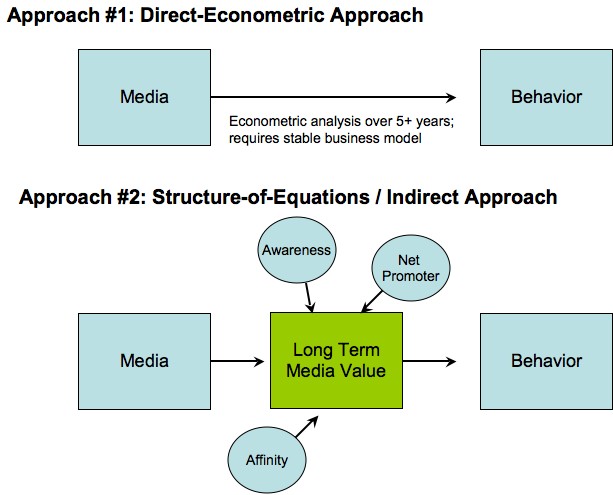
I've had a lot of conversations about with B2B marketers about how to value the long-term impacts of marketing communications. It's easy when you're looking at direct marketing, like email. We can look at the customer level for return data, applying CLV (customer lifetime value), and we can be pretty assured that we have an accurate statement of ROI. When you're talking about above-the-line media (TV, Radio, etc.), though, you have a tougher problem to solve. What I've seen is that most (95%) of media mix models done by companies, agencies, and specialty consulting firms tell you the impact of advertising for a maximum of about two quarters. Past this, causal effects blend in with the error term and we can't see the signal anymore. The trouble is, most marketers will tell you that above-the-line is bought for two reasons: to increase same period sales and to make customers like you more / think of you more over the long run.
Brand value models have been in use for a long time. Interbrand publishes the "Top 100 most valuable brands" every year. Its methodology is pretty top-down. Essentially they start with total revenue for the company and then subtract out stuff that isn't brand related. From this they just NPV "brand related" revenues and hit sort--voila.
This is a great methodology but doesn't really work for advertising optimization because you're not interested in the total brand value, only the part that was generated by media. So, you're back to a statistical methodology that attempts to link an independent variable (advertising spend, media weight, etc.) with a dependent variables (revenues or profits). There are two general ways to do this that I've seen.
1. Econometric-Direct Approach. This is my name for it. Essentially you're getting very long sets of time series data, many years in fact, and attempting to parse out the effect of media on the dependent variables using very long lag periods. There have been several studies done in academia on this front. A good sense of the debate around this issue can be found here.
Benefits: No latent variables required. No sampling of attitudes required. No multi-level analysis (or structured system of equations) required for analysis.
Hazards: Lots and lots of data required. Could be impossible to tease out long-term effects in a dynamic (or "chunky" market--such as software). I'm still not convinced it works at all.
2. Stucture of Equations-Indirect Approach. In this approach, which I prefer, you look at two relationships: First between media and an attitude (or set of attitudes) such as awareness, comprehension, or affinity, and then between these attitudes and customer behavior. Essentially, you're using the attitudes to indicate the latent variable "long run advertising value" in a structural equation model. The nice thing is that attitudes can be sampled easily over the long run (many companies are already doing this), giving good explicit indicators for the latent variable.
To successfully start modeling long-term media value using approach #2 above, you need patience, a good long-term attitude tracker study with DMA cross-sections, and the willingness to experiment some between DMAs. These data can also be supplemented with conjoint-type market research.
Subscribe to:
Posts (Atom)