Showing posts with label data warehouse. Show all posts

Friday, September 25, 2009

Build vs. Buy to Land Marketing Analytics

I break analytical marketing into two families: performance optimization and performance improvement. Both families are equally popular these days. However, I'm still seeing significant frustration landing "analytical marketing", particularly in large companies. Smaller "born on the web companies" have no problem at all with this. Generally, the founders of these companies built the core strategy around analytics, hired people comfortable with these concepts, and have woven analytics into the core IT systems of the company as it has grown.

However, for larger "digital immigrant" companies, weaving analytics into marketing can be a daunting task. It's no accident that large global consultancies like IBM are investing heavily in analytics consultants. They've realized a simple truth: that no matter how many fancy new airplanes an airline has, they won't get off the ground without skilled pilots and mechanics. So, why not just book a ticket on United?

I can't take credit for the pilot / mechanic / airplane /airline analogy, but it's a good one so I'll use it shamelessly. To be clear:
  • Pilot = analytics marketing professional. A dork like me. There are different kinds of pilots. There are the ones that can only fly the plane, and then there are the ones that can also probably start their own airline.
  • Mechanic = data warehouse, SAS server, web analytics etc. software guru. These are the people that actually understand how the plane is put together and fix it when it breaks.
  • Airplane = the data warehouse, SAS, etc. software itself, or "cloud", doesn't matter. These are the $100,000 + CAPEX investments that make analytics possible.
  • Airline = IBM Global Services etc.--the firms that will just do this stuff for you. You just get on the airplane and it flies you where you want to go.

Looking at it from the company's perspective that just wants to get better at customer insight, targeting, ROMI, web ad optimization, etc., it's a very difficult strategic question: Where should I start? One could make an argument for starting at any of the four bullet points above, and I can think of case examples of companies who have gone down each path. But, I'll give you what I think the answer is now.

  • Don't even bother hiring mechanics if you are less than $500 M in revenue, unless you were born on the web. It's extremely expensive; the people that can truly build great systems are few and far between, and the pain will be enormous.
  • Everyone who wants to do analytics needs at least one good "senior pilot". All the other stuff might be outsourced, or you might fly United, but you need one person who really understands the stuff and can direct vendors, etc.
  • Whether to buy airplanes or not depends on business context. I'm a huge fan of the cloud and renting airplanes, and this is getting more and more feasible. Companies that provide managed ROMI environment that still house your data like MSights are a powerful option. However, for large companies, buying other components selectively can make sense. And it certainly makes sense if you were born on the web.
  • Full-service airlines can also make a lot of sense. Totally outsourcing all analytics to IBM might be the way to go if your culture is simply not built around digital and it's not a core focus. Over time, the company may get enough digital natives on board to make analytics a core competency.

Thursday, August 27, 2009

Creating a Dynamic View of Customer Status

When trying to manage a population of customers in a high frequency-of-purchase business where unique customer data are obtainable, it can be helpful to look at a grid comparing:

  • Frequency of purchase in the last "active" 30 day period, and;
  • Last purchase date.

This grid will look like this, when the report is run against the current state of customers:

Another way to look at these dimensions is as continuous dimensions where:
  • Freq of Purchase {0-->∞}
  • Last Purchase {0-->∞}

And each customer is plotted along these dimensions.

But, to make things convenient, we cut off "last purchase", at, say, 90 days, and frequency at, say, 4 X for our table. We can then bucketize these scalar dimensions into a neat 4X4 (or nXn) grid like the one above.

A simple customer count in each bucket lets one understand current state. This is a perfect application for an OLAP reporting tool. It's also interesting, however, to understand dynamics: How customer status has changed from previous periods--the real point of this post.

To do this, I use the concept of vectors. A table such as the following can be created:


We can then simply average all of the movements for each unique starting cell location. For example, for the starting cell 1,1, which would correspond to Frequency of Purchase = 1 and Last Purchase <= 30 days, we might get {1.283, 1.321} for movement. These two numbers are the sides of a right triangle, the hypotenuse of which is the vector of customer movement.

There is an even more precise way to do this, which is to measure actual change in frequency of purchase and last purchase for each customer. In this way, we can actually measure customers who are going "beyond the edges" of our table--for example purchasing more than 4 times per 30 day period.

We can then plot our vectors in our table, which might look like this:


Each vector "direction" has a meaning. For example, "North" means more recent; "East" means more frequent / valuable, and so on.

We can also get to the velocity of change--the second derivative--by simply differencing two vectors, say, a month apart. These would tell you how a dynamic trend like the one above is changing. This is a very useful indicator of how marketing programs are impacting customer status.

This approach can also be used with virtually any customer attribute replacing these two dimensions, for example:

  • Total value
  • Customer Lifetime Value
  • Category-Specific Activity
  • Etc.

This is a neat approach that can be done with basically any pivot table / OLAP tool and a database of customer purchases.


Monday, November 20, 2006

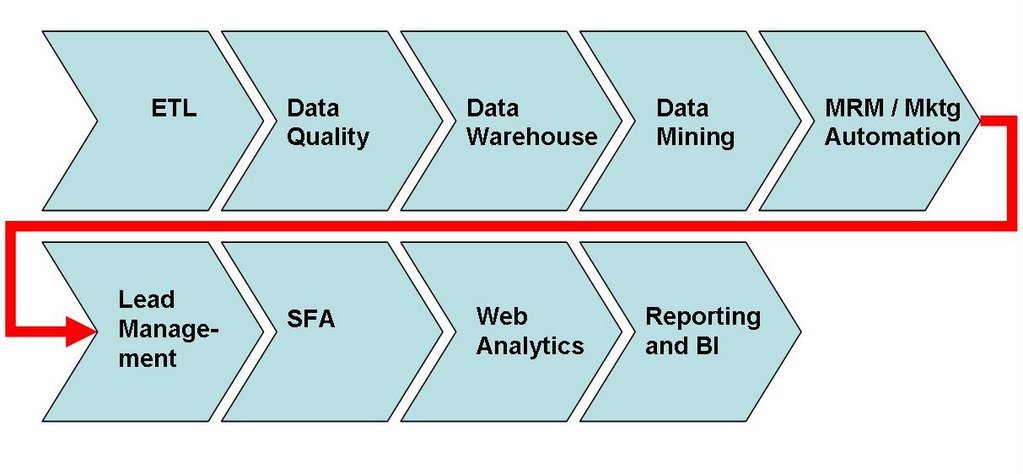
Attempt at Categorizing Technology for Managing the B2B Pipeline


NOTE: I’ll keep this post “live” and updated as I get comments and as things change in this space. Latest update: 11-29-06. Updates since original post in red.

I’ve been trying to categorize all the technology that’s available out for B2B marketers into neat buckets. I’m sure Forrester and Gartner have done much better jobs at this than I have, but their reports cost money. For those of you who want a quick-and-dirty categorization of technology with links to company web sites, this post is for you. Please comment to point out companies I’ve missed.

There are a lot of “merging” technologies in this list. What this means is that some technologies started in one place and have spread into others. I’ve tried to note these, but have left the technologies in their “original”—and thus ostensibly focus—space.

Extraction, Transformation, Loading (ETL):

Informatica: PowerCenter http://www.informatica.com/products/powercenter/default.htm

Native Database ETL: SQL Server 2005, Oracle 10g, IBM DB2 all have native ETL technology that is clearly getting better and could be making Informatica obsolete—we’ll see. Informatica is still the Cadillac.

IBM: Information Integration http://www-306.ibm.com/software/data/integration/
Thanks to Vincent for his post alerting me of this miss. Check out his post for a comparison of Informatica and IBM Information Integration.

Data Quality:

Informatica: Data Quality
http://www.informatica.com/products/data_quality/default.htm

Trillium: Owned now by Harte-Hanks
http://www.trilliumsoftware.com/

Dataflux: Owned by SAS... wait everyone is getting owned in this space...
http://www.dataflux.com/

Data Warehouse (pre-built and otherwise):

Upper Quadrant: UQube
http://www.upperquadrant.com/

Oracle Data Warehouse Builder: http://www.oracle.com/solutions/business_intelligence/warehouse-builder.html

All other relational databases can function as data warehouses. There are very few “pre-built” marketing data warehouses out there. Anyone who knows of any others please comment.

Data Mining:

SAS: Enterprise Miner
http://www.sas.com/technologies/analytics/datamining/miner/

SPSS: Clementine
http://www.spss.com/clementine/

Oracle: Oracle Data Miner
http://www.oracle.com/technology/products/bi/odm/odminer.html


Campaign Management / Marketing Automation / MRM:

Aprimo: Aprimo Enterprise Marketing Management
http://www.aprimo.com/approach/emm.asp

Unica: Unica Affinium Suite / Enterprise Marketing Management
http://www.unica.com/

SAS: SAS Marketing Automation—more focused on analytics than process, but improving
http://www.sas.com/solutions/crm/mktauto/

Siebel: Siebel Enterprise Marketing—suite contains multiple marketing applications but focused on / started with MRM
http://www.oracle.com/applications/crm/siebel/enterprise-marketing/index.html


Lead Management:

Eloqua: Eloqua Conversion Suite—They have a “complete” suite but are strongest in lead management.
http://www.eloqua.com/ps/products_ecs.asp

Marketo: Heard from Jon Miller about his new on-demand marketing automation solution. He also mentions in his post that he thinks Lead Creation and Lead Management shouldn't be separated. I agree that a lot of software does both, but in my experience a lot of companies thinking of them separately, so I'm keeping them discrete. The site currently site says "In Quiet Mode"... hopefully more coming soon.
http://www.marketo.com/index.html


Sales Force Automation:

Siebel: Siebel Sales
http://www.oracle.com/applications/crm/siebel/sales/index.html

Salesforce.com:
http://www.salesforce.com

Microsoft: Dynamics CRM
http://www.microsoft.com/dynamics/crm/default.mspx

SAP: MySAP CRM
http://www.sap.com/solutions/business-suite/crm/index.epx


Web Analytics:

24/7 Real Media
http://www.247realmedia.com/

Elytics, Inc: Elytics Analysis Suite
http://www.elytics.com/products_overview.htm

Google: Google Analytics—free and very good…you have to think they’re going to be continuously improving and eventually offering an “Enterprise” edition
http://www.google.com/analytics/

IBM: IBM SurfAid Analytics Services
http://surfaid.dfw.ibm.com

Omniture: Omniture SiteCatalyst
http://www.omniture.com/products/web_analytics/sitecatalyst

SPSS: SPSS NetGenesis
http://support.spss.com/newSupport/ProductsExt/NetGenesis/ProductMatrix.htm


Reporting and Business Intelligence:

Cognos: Cognos 8 BI / Reporting
http://www.cognos.com/products/cognos8businessintelligence/reporting.html

SAS: SAS Business Intelligence
http://www.sas.com/technologies/bi/

Business Objects: Business Objects XI / Crystal Reports
http://www.businessobjects.com/products/

Microsoft Suite included Business Scorecard Manager, SQL Reporting Services, Office Live, etc.—note: Microsoft’s BI position is still quite confusing, but their overall portfolio of products is compelling.
http://www.microsoft.com/sql/solutions/bi/default.mspx
www.microsoft.com/office/bsm/

Vincent also alerted me to include Hyperion as a BI provider. Hyperion's Essbase and related products are mainly concentrated in the financial space, but they have some interesting unique technology. http://www.hyperion.com/products/
I was intrigued at the "Essbase Analytics" product which seems new (last time I worked in Essbase was four years ago) and seems to allow enterprise-level scenario modeling... could be interesting for mix optimization.

Tuesday, November 14, 2006

Why Data Warehouse for B2B Marketing?

"Data warehouse" is another one of those words that is used with ubiquity but is probably truly understood by few. For B2B marketers, it is becoming a more and more critical concept. What is a B2B marketing data warehouse? I'll take a shot at a clean definition. From Wikipedia: "A data warehouse is a computer system designed for archiving and analyzing an organisation's historical data, such as sales, salaries, or other information from day-to-day operations." (link). Another interesting definition (from same Wiki): "A data warehouse is the main repository of the organisation's historical data, or its corporate memory."

So what purposes does a data warehouse fulfill for a B2B marketer?

1. Single version of the truth on performance. A common problem for marketers--which I have perseverated on for hours on this blog--is a perceived lack of accountability for marketers. A marketing data warehouse functions as the best source of data in the company. It also has the advantage of being time-fixed; that is, you don't have records changing as users enter new data--the picture of the data is fixed in time.

2. Single view of the customer. CRM systems are myopic in that they look mainly at customer interactions; ERP / Financials focus on financial and accounting data. A marketing data warehouse can integrate operational systems' views into one unified, de-duped view of each customer.

3. Key for data enrichment. Enriching data in operational systems is cludgy and almost always causes problems. Say you want to add D&B data to your records. It's far easier to send a data warehouse query to D&B for matching and then re-append this back into your warehouse. If your reps need the data too in CRM, this won't be a problem--this data in your warehouse should theoretically be as clean or cleaner than in any of your operational systems.

4. Use it for direct marketing analytics. The data warehouse is ideally suited for modeling because it is fixed and clean, and merges all possible relevant data sources in one place. A data mining solution like SAS EM or Clementine can easily sit atop a marketing data warehouse and run models all day with very little additional data. Lists can be generated directly from the warehouse and then exported out to Marketing Automation or SFA.

Here's an interesting factoid: it seems to me that most marketing data warehouses are custom. Why is this? Isn't there a standard architecture that could be used for all marketing data warehouses--a master set of tables where needed elements could be turned on and off on demand? There are some companies out there that do this, and Siebel-Oracle has an option that is pretty good. It'll be interesting to see where this goes in the future.

Monday, October 23, 2006

Marketing Stim-Response Data Warehouses

Question: What do you need before you have any business starting media mix optimization or direct marketing rationalization?

Answer: A marketing stimulus-response data warehouse.


I was reading the marketing news this morning and came across a press release for a "Physician database marketing system" from CPM that "is specifically designed to link internal, external and computed data to the main consumer CRM system..." I have no idea if this system works or not, but it highlights an interesting trend. I've started to see these "supplementary data warehouses" in the market place... Another good one to look at is Upper Quadrant.

CRM systems, I would argue, are first and foremost about capturing transactions through a user interface. Even Siebel's Marketing Enterprise is largely about getting program planners, direct marketers, etc., to enter in their campaigns, tactics, etc. in an organized way. This was information that was, before CRM, largely uncaptured. Where CRM systems have fallen down is giving a holistic view of sales and marketing stim-response across the enterprise. This is because CRM system are, by definition, somewhat siloed (or a lot siloed). It is unrealistic to expect the Salesforce.com installation to contain financial outcomes of leads, a complete view of the marketing database, time series data on advertising, etc.

So, the solution is the marketing data warehouse. Up until now, these have existing in two flavors and they were almost always customized / built by system integrators. Flavor one are the customer / lead / direct marketing data warehouses. These are primarily executional. Flavor two are the stim-response databases that tend to be primarily analytical. There are a couple places where I've also seen attempts at one data warehouse that covers both executional DR and analytical in one.

My point here is simply that there is huge white space for a company that can come in and deliver a largely pre-baked marketing data warehouse solution that pulls data in from CRM, Marketing Automation, ERP / Financials, and, most importantly, commonly used external sources. Getting back to Upper Quadrant, they are starting down this path. They are building the hooks into Nielsen, common call center switches, competive data, media trackers, etc. so that customers can get marketing data warehouses up and running quickly. It should be an exciting space to watch over the next couple years.