Showing posts with label Lead Management. Show all posts

Monday, January 11, 2010

Affordable Transaction Economics

I'm always looking for more scientific ways to spend money on marketing, as people who consistently read this blog  know.  I spend a lot of time looking at Return on Marketing Investment (ROMI), for example.  Lately, I've been dealing a lot with pipeline marketing strategy, and I stumbled upon something that is probably fairly obvious, but I thought I'd outline it formally. 

My friend and mentor Tim Furey wrote a book in 1999 called The Channel Advantage.  It was a great book, and its simple premise was "match the transaction to the channel that can afford to handle it."  There were other key ideas, but this was the one that stuck.  In other words, rebuy channels go through e- and tele-channels, big new servers through face-to-face.  The reason, simply, is that it costs $10 to take an inbound phone order, and $250 (at least) to drive out to someone's office.

I wanted to take this concept and apply it to a more dynamic problem, the pipeline, specifically nurturing leads.  When you think of a lead, it has a "born on date" and then you continue to do "stuff" to it that costs money.  Every time you do "stuff" the acquisition cost has increased.  So, a key metric for lead nurturing has to be "cumulative marketing dollars spent."  That's the basis for affordable transaction economics (ATE) applied to lead nurturing.

In other words, affordable transaction economics (ATE) is simply a way to optimize pipeline marketing activity at every stage of the relationship. The one premise is “don’t spend more cumulatively on a lead than we forecast the lead to contribute to our operating profit.” ATE depends heavily on a lead scoring model, ideally one that can forecast the total value that will result in a lead.  Say at day 1, my forecasted lead value is $10. That means that I should have spent no more than $10 on acquiring and nurturing that lead. But, on day 2, we get a lot more information from that lead, and the forecasted lead value goes up to $200. Now, I can afford a telephone call and more. This continues on and on. A case example of how ATE can be used to guide spending on lead nurturing is outlined in the table below.


The constraint of spending no more cumulatively than the forecasted operating profit is an outer limit, by the way. There should be some percentage of revenue that marketing targets for acquisition cost—say, 10%. This target will usually be lower than operating margin.

What does this mean operationally?  For marketers who own the upstream end of the pipeline, it means creating two new metrics, cumulative spend per lead (CSPL) and forecasted affordability per lead (FAPL).  When CSPL > FAPL, this metric should turn red.  These KPIs are nice because they can flow from the individual lead level all the way up to a line of business.  To do this, we need to think about what affordability is (how much should I spend per dollar on acquisition?) and we need a good lead scoring model that look at eventual lead value.

ATE can also be used very effectively as a planning framework for designing lead nurturing campaigns.  Essentially, the marketer can now plan the mix for a $1 lead, a $10 lead, a $100 lead, and a $1000 lead.  This simplifies thinking considerably around what can be very hairy process flows.

Wednesday, December 16, 2009

Using Audience Targeting to Own the Latent Pipeline

B2B marketers are intimately familiar with the concept of a funnel or a pipeline. Whichever term you use--you might use both--the ideas are the same from company to company. A lead is entered into a system at some point in time. It might be someone inquiring on the web site, or it might even be a name from a list. From this point onwards, that lead can either move forward, do nothing, or drop out of the system. The resulting graphic looks like a funnel.

Having covered that ground, let me state up front that this post is not about pipeline management, acceleration, nurturing, systems, or email marketing. This post is about a fundamental problem with the funnel concept as operationalized at most B2B marketing organizations today, and what I think is a pretty seminal idea on how to fix the problem.

The problem with funnels is that they're missing a lot of the folks that are actually going through the purchase process. This is because we as marketers are dependent on our own internal systems to track these folks. Our own websites; our own emails; our own sales reps; you name it. However, we know there are many individuals with needs that are going down an awareness / consideration / trial / purchase process that we are completely oblivious to. I call this the latent pipeline. For analytics geeks, this should be a comfortable term. It is the implicit pipeline that we don't have information about but that we know exists.

I'd argue that the latent pipeline can be broken into two parts. The first part is the upstream part of the funnel that could be defined as "pre-company web site". This is when latent prospects are starting to think about their needs and what they're going to go do. Today, this is going to be largely addressed via search, assuming that we can intersect people when they type in search terms. There is no question that this is a powerful tool for intercepting prospects, but I'd argue that there's an even more powerful way to target them. More on that later.

The second part are the folks that are going through our stages, as defined via our systems, that we don't know about. So, when we have 10 leads that are "qualified", there are another 50 leads out there that are being qualified by other companies. We don't know about them, so chances are, we'll never get to pitch to them. Ouch! That's pretty harsh.

So, we've defined a pipeline that has an explicit and a latent component, that will look something like this:

This fundamentally changes the concepts of B2B marketing, when you think about it.
  • Acquisition marketing really becomes about understanding the top of the latent funnel
  • The scope of CRM can be expanded to include not just leads / opportunities in our CRM system, but to leads / opportunities in other company's CRM systems

I'm not suggesting that we all go do industrial espionage and steal other firm's CRM data. I'm suggesting that through online audience ownership, we can extend the CRM layer from the explicit to the latent, via display advertising. I already posted on this once, so read that one. Basically, I'm arguing that we need to take a few steps to own the latent pipeline:

  1. Understand our audiences
  2. Map their typical B2B Internet behavior and map their pre-buying cues
  3. Build analytical models to tag them
  4. Target them via display advertising before they ever come to our site
  5. Keep doing search marketing

In other words, create a rich, targeted online tapestry that is always on, and no longer shackled to company web sites and email. B2C marketers are ahead on this, but B2B has so much more potential.

I know this needs more detail. Next post will be on how one might do the steps above and make it work.

Friday, November 07, 2008

MarketingSherpa Article--Boosting Lead Scores in a Downturn

In a previous post, I had mentioned that MarketingSherpa had interviewed me on lead qualification in a downturn. Well, the article's out, and I guess I said smarter things than I thought because there is some good stuff in there. It's honestly worth reading, I swear. There are other people interviewed too, that said smarter things than I did.

Summary of the "Seven Tips for Surviving in an Economic Downturn":

Tactic #1. Emphasize quality, not quantity in your lead database
Tactic #2. Create a behavioral model based on recent activity
Tactic #3. Validate your hypotheses with third-party data
Tactic #4. Emphasize recent activity in your lead scoring
Tactic #5. Reassess value proposition for your core audiences
Tactic #6. Adapt content strategies to your lead-nurturing program
Tactic #7. Use telemarketing to get best insight into prospects’ needs

Friday, October 24, 2008

B2B Pipeline Optimization


Interesting case study available on http://www.market-bridge.com/ on pipeline optimization for Siemens Medical. Basically, the idea was to take a look at pipeline performance and benchmark against best-in-class competition at each stage. Gaps in performance have a cumulative effect through the funnel... each funnel stage is addressed through a specific process improvement. The results in terms of revenue impact were pretty extraordinary (about $100M over 18 months.) You have to register to view the case study but it's worth it as there are some really good tidbits in there.

Wednesday, October 15, 2008

Lead Qualification in the New (Bad) Economy

I was talking today to Marketing Sherpa. They're wondering if any B2B companies are using analytics to qualify leads on the basis of their "health" or "likelihood to close" given contracting budgets. I wasn't aware of anything specific, but it's certainly SOP in B2C. Car Insurance, for example, are qualifying "real value" all the time just on the basis of the numbers people fill in on display ads.

Businesses do it with BANT--budget, authority, need, timing. This is obviously still in play in today's environment, maybe even more so. However, is there another way to do it that keeps track of industry dynamics... the micro dynamics in an economy? For a company like Microsoft or Cisco that is getting literally 1000s of leads a day through search, display, partners, inbound call centers--what if they could prioritize these leads on the basis of "real economic activity?"

It's an embryonic idea, so pardon if it's a bit crude. The idea is that you take a look at trailing 3 month data on "proposal to close" discrete events. So you're looking for proposals that closed and proposals that actually were lost. Then you'd put a data mining algorithm on it against all the industry and firmographic data you had on the close. So you'd be looking at city, SIC code, company size, etc... all of the variables that are relevant from an economic perspective. This could give you a predictive model that changed daily on which companies are more likely to close in a tough economic environment, and would facilitate reprioritization of closing efforts on these types of companies.

You'd have to be careful on bias here, obviously. But, I think it's an interesting idea. You could even enrich the data with region-specific industry insights. E.g. if the beige book shows a bright spot for small manufacturers around Philadelphia, you could manually crank up that part of the model.

Descriptive statistics would be interesting, too. A daily report could be built showing changes in close rates by company type (SIC code), geography, etc. This could be compared to economic data and would provide a good macroeconomic headlights tool for a B2B company.

These same ideas could work at all stages of the pipeline. I guess this is my first post about specifically "marketing in the sucky economy" and I know everyone's going there now. Time to rev up the contra funds and jump on the bandwagon.

Wednesday, November 22, 2006

B2B Marketing Survey

The last lead management technology post has generated a lot of interest, so I'm going to do the first in a series of surveys... well, hopefully a series... we'll see what kind of interest I'm able to generate. The survey topic will be Lead Management Practices and I've tried to create something that is short (about 3-4 minutes) but will collect some pithy info. I'll keep updating the responses to the survey in this post as they come in... To give you a preview before you click the link, the questions deal with:
  • Current use of B2B marketing technology;
  • Current priorities around lead pipeline management;
  • Future priority areas / investment areas
  • Open ended text for entering in (as always) anything I've missed.

Click here to take the survey.

Please take the time to fill in the survey--it'll be great to see responses come in and then hopefully an insightful dialogue will develop.

Monday, November 20, 2006

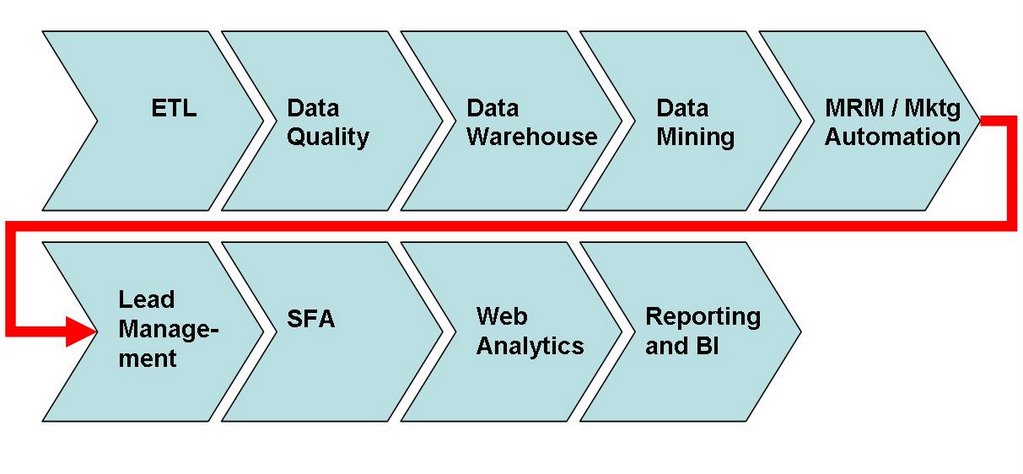
Attempt at Categorizing Technology for Managing the B2B Pipeline


NOTE: I’ll keep this post “live” and updated as I get comments and as things change in this space. Latest update: 11-29-06. Updates since original post in red.

I’ve been trying to categorize all the technology that’s available out for B2B marketers into neat buckets. I’m sure Forrester and Gartner have done much better jobs at this than I have, but their reports cost money. For those of you who want a quick-and-dirty categorization of technology with links to company web sites, this post is for you. Please comment to point out companies I’ve missed.

There are a lot of “merging” technologies in this list. What this means is that some technologies started in one place and have spread into others. I’ve tried to note these, but have left the technologies in their “original”—and thus ostensibly focus—space.

Extraction, Transformation, Loading (ETL):

Informatica: PowerCenter http://www.informatica.com/products/powercenter/default.htm

Native Database ETL: SQL Server 2005, Oracle 10g, IBM DB2 all have native ETL technology that is clearly getting better and could be making Informatica obsolete—we’ll see. Informatica is still the Cadillac.

IBM: Information Integration http://www-306.ibm.com/software/data/integration/
Thanks to Vincent for his post alerting me of this miss. Check out his post for a comparison of Informatica and IBM Information Integration.

Data Quality:

Informatica: Data Quality
http://www.informatica.com/products/data_quality/default.htm

Trillium: Owned now by Harte-Hanks
http://www.trilliumsoftware.com/

Dataflux: Owned by SAS... wait everyone is getting owned in this space...
http://www.dataflux.com/

Data Warehouse (pre-built and otherwise):

Upper Quadrant: UQube
http://www.upperquadrant.com/

Oracle Data Warehouse Builder: http://www.oracle.com/solutions/business_intelligence/warehouse-builder.html

All other relational databases can function as data warehouses. There are very few “pre-built” marketing data warehouses out there. Anyone who knows of any others please comment.

Data Mining:

SAS: Enterprise Miner
http://www.sas.com/technologies/analytics/datamining/miner/

SPSS: Clementine
http://www.spss.com/clementine/

Oracle: Oracle Data Miner
http://www.oracle.com/technology/products/bi/odm/odminer.html


Campaign Management / Marketing Automation / MRM:

Aprimo: Aprimo Enterprise Marketing Management
http://www.aprimo.com/approach/emm.asp

Unica: Unica Affinium Suite / Enterprise Marketing Management
http://www.unica.com/

SAS: SAS Marketing Automation—more focused on analytics than process, but improving
http://www.sas.com/solutions/crm/mktauto/

Siebel: Siebel Enterprise Marketing—suite contains multiple marketing applications but focused on / started with MRM
http://www.oracle.com/applications/crm/siebel/enterprise-marketing/index.html


Lead Management:

Eloqua: Eloqua Conversion Suite—They have a “complete” suite but are strongest in lead management.
http://www.eloqua.com/ps/products_ecs.asp

Marketo: Heard from Jon Miller about his new on-demand marketing automation solution. He also mentions in his post that he thinks Lead Creation and Lead Management shouldn't be separated. I agree that a lot of software does both, but in my experience a lot of companies thinking of them separately, so I'm keeping them discrete. The site currently site says "In Quiet Mode"... hopefully more coming soon.
http://www.marketo.com/index.html


Sales Force Automation:

Siebel: Siebel Sales
http://www.oracle.com/applications/crm/siebel/sales/index.html

Salesforce.com:
http://www.salesforce.com

Microsoft: Dynamics CRM
http://www.microsoft.com/dynamics/crm/default.mspx

SAP: MySAP CRM
http://www.sap.com/solutions/business-suite/crm/index.epx


Web Analytics:

24/7 Real Media
http://www.247realmedia.com/

Elytics, Inc: Elytics Analysis Suite
http://www.elytics.com/products_overview.htm

Google: Google Analytics—free and very good…you have to think they’re going to be continuously improving and eventually offering an “Enterprise” edition
http://www.google.com/analytics/

IBM: IBM SurfAid Analytics Services
http://surfaid.dfw.ibm.com

Omniture: Omniture SiteCatalyst
http://www.omniture.com/products/web_analytics/sitecatalyst

SPSS: SPSS NetGenesis
http://support.spss.com/newSupport/ProductsExt/NetGenesis/ProductMatrix.htm


Reporting and Business Intelligence:

Cognos: Cognos 8 BI / Reporting
http://www.cognos.com/products/cognos8businessintelligence/reporting.html

SAS: SAS Business Intelligence
http://www.sas.com/technologies/bi/

Business Objects: Business Objects XI / Crystal Reports
http://www.businessobjects.com/products/

Microsoft Suite included Business Scorecard Manager, SQL Reporting Services, Office Live, etc.—note: Microsoft’s BI position is still quite confusing, but their overall portfolio of products is compelling.
http://www.microsoft.com/sql/solutions/bi/default.mspx
www.microsoft.com/office/bsm/

Vincent also alerted me to include Hyperion as a BI provider. Hyperion's Essbase and related products are mainly concentrated in the financial space, but they have some interesting unique technology. http://www.hyperion.com/products/
I was intrigued at the "Essbase Analytics" product which seems new (last time I worked in Essbase was four years ago) and seems to allow enterprise-level scenario modeling... could be interesting for mix optimization.

Saturday, November 18, 2006

B2B Pipeline Management


"The Pipeline" and lead management are primary focus areas for many B2B marketers. B2B marketers have traditionally focused on generating leads, but more and more they are being asked to manage leads once they are "in the pipe". In fact, this is probably even more important than getting the leads in the first place, especially with sales forces that are overworked and have limited capacity.


There are a couple of key problems B2B marketers have traditionally faced once leads are in the pipeline.


  1. Bad Leads. If marketers handed off every lead that came in to the sales force, marketing would very quickly lose its seat at the table. So, marketers are forced to somehow qualify every lead. This is expensive and requires a lot of thought ahead of time.

  2. The Ready-to-Buy Problem. Customer know when they are ready to buy, but a lot of times companies don't. The common problem--customers are warm for a couple days, the company misses its chance (due to poor data, planning, systems, communications--the reasons are endless) and the customer is gone forever.

  3. Stale Leads. In a lot of companies I've seen, about 80% of the leads are essentially stale, but they are not treated differently than the fresh ones. This brings up a larger problem with leads. Even though in many companies campaigns are rigorously segmented and targeted, it's rare to see this kind of discrimination once leads are in the pipeline.

These three problems combine to create what I've sometimes heard called "The Lead Black Hole." Marketing creates all these leads... and they are swallowed up into the ether. So what are some solutions to these problems? Well there are a couple of things that I'd recommend to get started.


1. Pre-qualifying leads. The goal here is to minimize additional expense and single out those leads that don't need a human touch--either to move forward in the funnel or to get rid of altogether. This step is done with data only--no human interface necessary. It is important to realize that best-in-class organizations build models to both to cull out bad leads (e.g. company name ACME and name John Doe, etc. and to promote high quality leads further down the pipeline in certain cases.


2. Qualifying leads. A good proportion of leads that enter the pipeline will need to be qualified. Qualification is almost always done via telephone. While this is an acknowledged best practice, there are some challenges. First, some buyers will be ready to move very quickly on the initial qualification call. Traditionally, however, the lower cost tele resources used for qualification are not really able to handle this kind of "close" opportunity. Second, lead qualification is expensive. Qualifying a lead adds $30+ to the cost of every opportunity downstream in the funnel. In many cases, lead qualification is more expensive than lead generation.


3. Active Lead Nurturing. Once a lead is qualified, it is a mistake to automatically send it downstream to sales. Some leads are certainly ready for sales immediately--and it's critical to harvest these quickly. However, the vast majority of leads need to be warmed up before being passed off to sales. Nurturing then, is a thoughtful cadence or sequence of marketing touches designed to answer the buyer's questions and move him through his own funnel--I sometimes call this the latent funnel. Continuous reassessment is key--the movement to sales must happen at the right time to avoid losing opportunities to competitors or malaise.


4. Better Stage Tracking and Reporting. Good CRM discipline is key. In a lot of companies, the link between sales CRM and lead tracking is fundamentally broken in some way. There is an incredible variety of manifestations of broken CRM (I don't have to tell readers that) but suffice to say it's really hard to manage the pipeline without a good system for managing leads and getting pipeline information to tele, analytics, marketing managers, and sales.


I'll keep writing more posts on lead management and the pipeline over the months. I'll try to outline some blinded cases where I've seen things work well--and not work so well too.